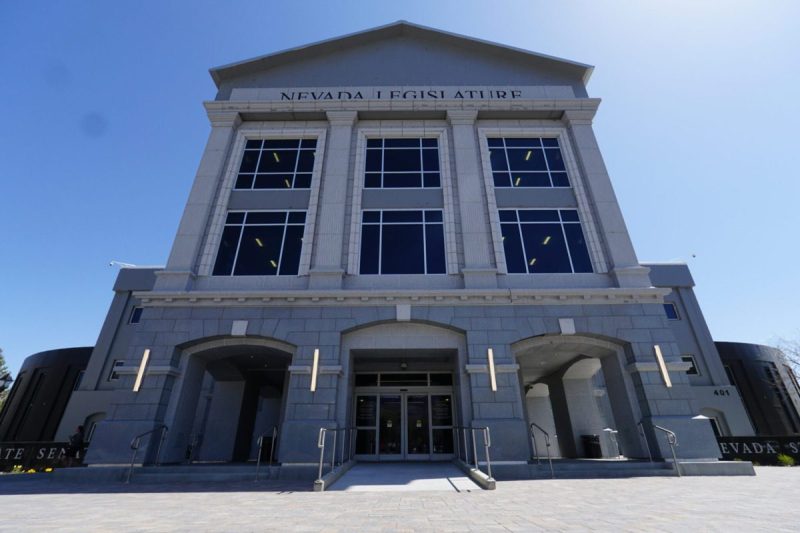
As election season approaches, Nevada has developed a framework for the safe use of AI in political campaigns.
In Washoe County, Republicans’ promotion of an AI-generated image of Nevada Democratic Attorney General Aaron Ford, who’s running for governor, is in line with a new Nevada law aimed at promoting artificial intelligence transparency in elections.
The visual, promoted on X, shows Ford in front of shutdown oil refineries, scratching his head, appearing dumbfounded with California Gov. Gavin Newsom pictured laughing above his head.
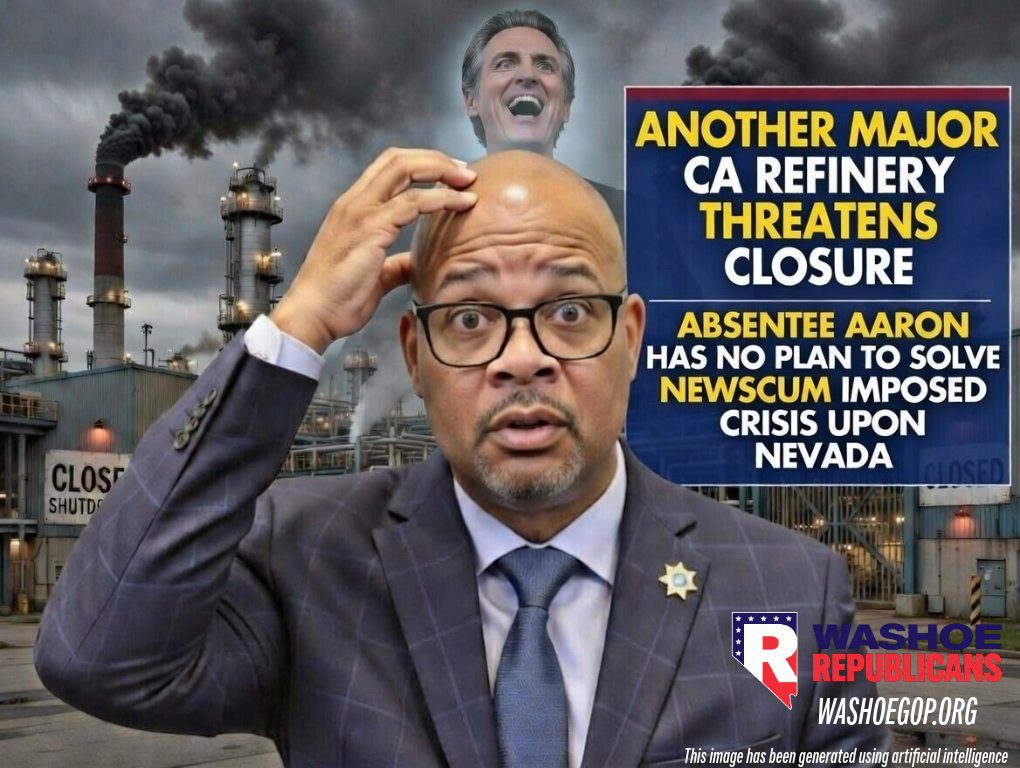
The new law, introduced by the Nevada Secretary of State and passed by the 2025 Legislature, now requires campaigns to disclose when political ads use “synthetic media”—including AI-generated or manipulated images, video, or audio. In the bottom right-hand corner of the Ford ad, Republicans included the mandated disclosure.
The law took effect earlier this year, making Nevada one of a growing number of states regulating fast-evolving AI technology ahead of the 2026 midterm and state and local elections. As artificial intelligence reshapes political campaigning, Nevada’s law is attempting to regulate deepfakes, or sophisticated visual imitations of people or circumstances that are meant to spread false information, in particular, according to Politico.
Under the measure, candidates, political action committees, and other groups must clearly indicate when content has been artificially altered. Failure to do so carries a $10,000 penalty, notably excluding television and radio broadcasters and social media and streaming platforms, placing the responsibility squarely on campaigns and political organizations.
The law not only mandates transparency for AI generative political content—it also specifies how disclosures must appear. Visual media must include a clear statement such as: “This (image/video/audio) has been manipulated.” For audio, the disclosure must be stated at the beginning, at the end, or at least every two minutes during a recording longer than two minutes. The audio disclosure must also be delivered at a volume and pitch “that can be easily heard by the average listener” and in the same language as the rest of the content.
Democratic Assemblywoman Brittney Miller, a member of the Legislative Operations and Elections Committee, which sponsored the bill, said the measure is not meant to stifle innovation and instead emphasizes transparency.
“The law is really a framework,” she said. “No one’s trying to hinder technology or business, but there needs to be some parameters on something like AI specifically, which easily and quickly will get out of control.”
She said elections are especially vulnerable to synthetic media campaigns.
Miller further acknowledged that the $10,000 penalty may not carry the same weight for every campaign or political group. Though she noted that the fine is significant to most Nevadans and small organizations.
“I also know that $10,000 is an extreme amount for many people, in many campaigns,” Miller said. “And like anything else, we have to start within a framework, within existing [statute] where we can, and move from there.”
The original bill language allowed fines of up to $50,000, but election officials changed it ahead of its first presentation last Spring to align with Nevada law governing other campaign transparency concerns, such as the required disclosure of paid advertisement funders.
The Nevada Secretary of State failed to respond to multiple requests for comments.