RGJ archives
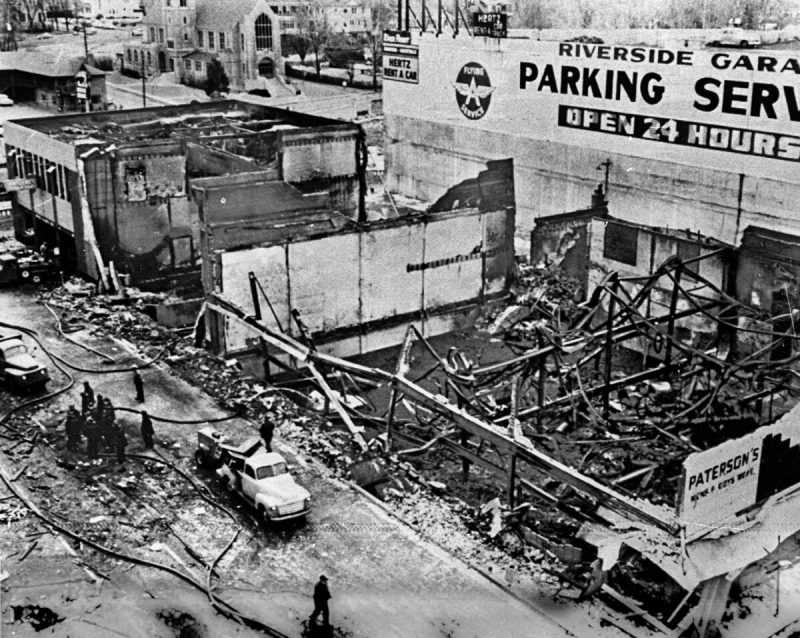
Two gas-fueled explosions, 30 seconds apart, ripped through downtown Reno on Feb. 5, 1957, killing two people and injuring dozens.
Both explosions, even though they were at ground level, were strong enough to register readings at the seismological station at the University of Nevada’s Mackay School of Mines. The resulting fire burned for more than a day.
Forty-nine people, including several firefighters, were treated at local hospitals for injuries and scores more had wounds treated by private doctors or ambulance crews.
In the days after the blast, losses were being estimated at $4 million, and a week later, as business owners and city personnel were able to get a closer look at the damage, the estimate was revised “to $7 million or more”, according to newspaper reports.
RGJ columnist Karl Breckenridge was a student at Reno High School less than a mile from the explosion. Here’s how he recalled the day in a column from 2008:
Elks Club manager rushes members outside before explosion
A number of downtowners noticed the odor of natural gas on Sierra Street near the Truckee River on that bright Tuesday noon hour in 1957. Yet none called the fire department or the power company, initially.
The first two telephone calls to the fire department came almost simultaneously at 12:53 p.m. from Spina’s shoe store and Paterson’s Men’s Store — both businesses on the west side of Sierra Street between the Truckee and West First. Across Sierra Street, Elks Club manager J. C. Kumle — aware that something was amiss — was quickly breaking up pinochle games and post-lunch chatter, marshaling members out of the Elks building, before some could retrieve their jackets if necessary, for it was a relatively warm day for early February.
‘We felt it before we heard it’
It was 12:59 p.m. as the first fire engine rolled up from the old main firehouse on Commercial Row, a short three blocks away, and as it stopped in front of the Nevada Shoe Factory a violent explosion blew windows out of the buildings for blocks around and scattered dust and wood and metal and bricks and roofing paper into the air, plunging downtown into virtual darkness. At Reno High School on Booth Street, we felt it before we heard it. The concussion that followed was unbelievable, a full mile west up the river from the blast. A second explosion followed, rivaling the first; a third was smaller.
Downtown workers and shoppers scattered, while emergency equipment from the Reno police and fire departments and Sierra Pacific Power converged on the scene. Fire quickly broke out in the graceful three-story Elks Home; by evening it would be reduced to a few partial brick walls and twisted steel beams and columns.
Across Sierra Street were three buildings lining the street from West First south to the river — Paterson’s building on the corner, then the building housing Spina’s Nevada Shoe Factory, Cambar Fabrics and Tait’s Shoes and the Slingerland Insurance Agency. Closest to the river was the Biltz building, housing the Sanford law firm and Realtor Ben Edwards upstairs, and the Kaylene clothing shop on the street level. They all caught fire, almost simultaneously, and were gutted by late afternoon.
That’s four buildings. The fifth building involved was the three-story Gray Reid Wright department store on the southeast corner of West First and Sierra Street. That well-built old building put up a valiant battle, as did the firefighters struggling to save it. And so they did, although it was necessary to remove the top floor before it re-opened. That structure would later become part of the adjoining Granada Theater. And recalling the Granada, that then-relatively-modern building was spared, thanks to an unbelievable deluge of water by Reno firemen who were joined in mid-afternoon by the Sparks, Carson City and Virginia City fire departments, Nevada National Guard personnel to augment the Reno police, and the Red Cross, who set up canteens to feed emergency workers.
Two die, dozens injured in 1957 Reno blast
Two people died that day. Adeline DuPratt was 57 years old and was struck by flying debris while crossing West First at Sierra. Frank Spina, 48, owned Nevada Shoe Factory at mid-block, and was found under a crushed automobile in front of his store several hours after the explosion. (A broken gas pipe attributed by some as the cause of the blast was discovered almost in front of that shoe store, three feet below the pavement.)
More than a hundred physicians hustled to Washoe Medical Center and St. Mary’s Hospital, and dealt late into the night with scores of firemen, store employees and shoppers injured by flying glass, smoke and splinters. J.C. Kumle, the executive secretary of the Elks Club, was lauded in the newspapers for his efforts in getting the lunch-crowd diners out of the club, for that was the largest concentration of people in the vicinity of the blast. The Elks later named the street that their building was built on for him (Kumle Lane, near the Reno-Sparks Convention Center).
USA TODAY Network via Reuters Connect